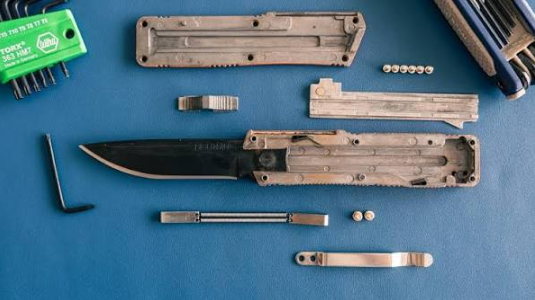
Most folding knives swing their blade out from the side of the handle. An out-the-front knife does something different: the blade travels in a straight line, forward through the top of the handle, and then back again. That movement looks simple, but it depends on a carefully balanced spring mechanism, precise internal tracks, and a blade lock that must stay firm under pressure. This guide explains how OTF knives work, what separates a double-action OTF from a single-action one, why some models misfire while others run for years, and how to judge build quality before buying. It also compares the OTF with the butterfly knife, a design that shares the collector appeal but works on entirely different principles.
Key Takeaways
- An OTF knife fires its blade straight out of the handle using a spring, carrier, sear, and lock running in a precision track.
- Double-action models fire and retract with the same slider; single-action models fire automatically but reset by hand.
- Misfires usually come from grit, weak springs, firing against resistance, or poor factory tuning.
- Judge quality by blade play, consistent action, slider feel, tolerances, materials, and whether the maker hand-tunes and tests each knife.
- Butterfly knives share the collector appeal but work on a completely different, hand-operated pivot design.
- Check local law before buying or selling; automatic knives are restricted in the UK and many other places.
See also: Managing Combined Radial and Axial Loads in Compact Assemblies
What an OTF Knife Is
OTF stands for out-the-front. The blade sits inside a flat handle, and a slider or button on the handle sends it forward to lock in the open position. On most modern designs, the same slider pulls the blade back inside. Because nothing swings sideways, the knife can be opened with one hand while the other hand is busy, and the closed knife is a slim rectangle with no exposed edge.
The design dates back more than a century and was long associated with military and tactical use. Today it is far more common in the hands of collectors, outdoor users, and everyday-carry fans who appreciate the engineering as much as the function.
A note on legality
Automatic knives, including OTFs, are restricted or banned in many places. In the United Kingdom, for example, it is illegal to sell, import, or carry most automatic opening knives. Rules in the United States vary by state, and many European countries have their own limits. Anyone interested in these knives should check local law before buying, and retailers should confirm what they are allowed to sell in each market.
The Core Parts of an OTF Mechanism
Every OTF knife is built from the same basic components, even if the shapes and materials differ.
| Part | What it does |
| Handle or chassis | Holds the internal track and all moving parts; usually aluminium, zinc alloy, or titanium |
| Blade | Runs along the track; attached to a carrier at its base |
| Blade carrier | The sled that the blade sits on; it engages the spring and the lock |
| Main spring | Stores energy when the slider is moved and releases it to fire the blade |
| Slider or thumb switch | The external control that charges the spring and triggers release |
| Sear or catch | Holds the spring under tension until the slider passes the release point |
| Lock | Secures the blade in the open or closed position so it cannot move on its own |
| Internal track | Guides the blade carrier in a straight line with minimal play |
The quality of an OTF knife comes down to how well these parts fit together. A few hundredths of a millimetre of extra clearance in the track produces blade wobble, and a spring that is slightly too weak produces a soft, unreliable deployment.
Single-Action and Double-Action Explained
Single-action OTF
In a single-action design, the spring fires the blade out, but it does not bring it back. To close the knife, you pull a charging handle or lever that draws the blade into the handle and re-tensions the spring at the same time. Single-action knives usually fire harder and faster because the spring does only one job, and they were the original automatic design. The trade-off is the extra step to reset.
Double-action OTF
In a double-action design, the slider both fires and retracts the blade. Push forward and the blade deploys; pull back and it retracts. This is the design most people have in mind when they think of an OTF knife, and it is by far the most common today. Everything happens with the thumb, which is why the double-action OTF is popular for one-handed use.
The double-action mechanism is harder to build because the spring must work in both directions. That added difficulty is where cheap knives fail and well-made ones shine.
How a Double-Action OTF Fires, Step by Step
- Rest position: The blade sits inside the handle. The carrier is held by the lock, and the main spring is relaxed or lightly tensioned.
- Charging: As you push the slider forward, it drags one end of the spring with it. The carrier is still held by the sear, so the spring stretches and stores energy.
- Release: Near the end of the slider’s travel, the slider passes a release point and the sear lets go of the carrier.
- Deployment: The stored energy in the spring snaps the carrier and blade forward along the track in a fraction of a second.
- Lock-up: At full extension, the carrier engages the lock, which holds the blade rigid for cutting.
- Retraction: Pulling the slider back repeats the process in reverse: the spring charges, the lock releases, and the blade snaps back into the handle.
The whole cycle takes well under a second each way on a properly tuned knife.
Why OTF Knives Sometimes Misfire
Misfiring is the most common complaint about OTF knives, and it almost always has one of four causes.
Grit in the track
Sand, lint, and dust inside the handle slow the carrier and absorb spring energy. The blade either stops short or crawls out weakly. This is the number-one cause and the easiest to fix with compressed air and a drop of light oil.
Weak or fatigued springs
Low-cost knives often use springs that lose tension after a few hundred cycles. Quality manufacturers use high-tensile spring steel and test it for fatigue resistance before assembly.
Firing against resistance
Most double-action OTF knives include a safety feature: if the blade meets an obstacle while deploying, the carrier disengages from the spring and the blade stops rather than forcing through. This is intentional. You then push the blade forward by hand to reset it. People sometimes mistake this safety behaviour for a fault.
Poor tuning at the factory
Spring tension, sear engagement, and track clearance must be set by hand on each knife. Factories that skip this step ship knives that work inconsistently from the first day.
What Separates a Quality OTF From a Cheap One
Because the mechanism is hidden, buyers have to judge by what they can see and feel. These are the signs of a well-built knife:
- Zero blade play: With the blade deployed, push it side to side and up and down. There should be no movement.
- Snappy, consistent action: The blade should fire with the same speed every time and lock audibly.
- Smooth slider: The thumb switch should move cleanly without catching or grinding.
- Tight tolerances: Look at the gap where the blade exits the handle. It should be narrow and even.
- Good materials: Blade steels such as D2, 440C, 154CM, S35VN, or M390, and handles in 6061-T6 aluminium or titanium, indicate a manufacturer that cares about the parts.
- Hand assembly and testing: Manufacturers that state each knife is hand-tuned and stress-tested before shipping are usually the ones whose knives still work after years.
Direct manufacturers such as OTF Factory, which specialises in OTF knives, automatic knives, and butterfly knives, explain this kind of process openly: CNC machining of the internal chassis to near-zero tolerances, Rockwell hardness testing of blades and locking parts, hand-tuning of spring tension on every unit, and repeated rapid-fire testing before a batch leaves the factory. Whether you are a collector buying one knife or a retailer ordering a custom run, those are the questions worth asking any supplier.
Blade Steel and Handle Materials
Steel
| Steel | Character | Typical use |
| D2 | Tough, holds an edge well, semi-stainless | Budget and mid-range working knives |
| 440C | Stainless, easy to sharpen | General purpose |
| 154CM | Balanced edge retention and corrosion resistance | Mid-range |
| S35VN | Excellent corrosion resistance and edge life | Premium everyday carry |
| M390 | Very long edge retention | Collector and high-end models |
| Damascus | Layered pattern steel, decorative | Collector pieces |
Handles
Aluminium is light and machines precisely, which suits the tight tolerances an OTF needs. Zinc alloy is heavier and cheaper. Titanium is the premium choice, strong and corrosion-resistant. Inlays in carbon fibre, G10, or patterned materials add grip and visual interest without affecting the mechanism.
OTF Knives and Butterfly Knives: Two Very Different Mechanisms
Butterfly knives, also called balisongs, are often grouped with OTFs because both appeal to collectors and both are regulated in many places. Mechanically they have little in common.
| Feature | OTF knife | Butterfly knife |
| How it opens | Spring fires the blade straight out | Two handles rotate around the blade by hand |
| Hands needed | One | One with practice, two for beginners |
| Moving parts | Spring, carrier, sear, lock, track | Two pivots, latch |
| Main quality factor | Spring tuning and track tolerance | Pivot smoothness and handle balance |
| Typical appeal | Speed, one-handed convenience | Flipping, skill, tradition |
A balisong’s quality is judged by how smoothly it swings, whether the handles have play at the pivots, and whether the blade taps the handles when closed. Manufacturers that make both types usually tune them differently: OTFs for the action, balisongs for the swing.
Keeping an OTF Knife Working
A little maintenance prevents almost every problem.
- Blow out the mechanism with compressed air after dusty or sandy use.
- Add one drop of light oil to the track every few months. More oil attracts dirt.
- Wipe the blade dry after cutting anything wet or acidic.
- Never fire the blade against a surface or inside a pocket.
- If the blade stops mid-travel, push it forward by hand to reset rather than forcing the slider.
- Store the knife closed, in a dry place.
A Short Example
A small outdoor-gear shop received a batch of low-cost OTF knives from a trading company and found that one in five misfired within a month of customer use. Returns ate the margin. The owner switched to a direct manufacturer that hand-tuned and stress-tested each unit and could show its quality-control process. The new batch cost slightly more per knife, but returns dropped to almost zero, customer reviews improved, and the shop was able to order a small custom run with its own logo on the handle. The lesson was simple: with OTF knives, what happens inside the handle before shipping matters more than the price on the tag.
Frequently Asked Questions
What does OTF mean on a knife?
Out-the-front. The blade deploys straight forward through the top of the handle instead of swinging out from the side.
Are OTF knives reliable?
Well-made ones are very reliable. Most failures trace back to dirt in the mechanism, cheap springs, or knives that were never tuned at the factory.
What is the difference between single-action and double-action OTF knives?
Single-action knives fire the blade automatically but must be reset by hand. Double-action knives fire and retract with the same slider.
Why did my OTF blade stop halfway?
Most likely the blade met resistance and the safety disengaged the carrier from the spring. Push the blade forward by hand to reset it, then check the track for grit.
Are OTF knives legal in the UK?
Most automatic opening knives are illegal to sell, import, or carry in the UK. Always check current law in your country before buying.
Which is better, an OTF knife or a butterfly knife?
They serve different purposes. OTFs offer fast one-handed deployment; balisongs are valued for flipping skill and traditional design. Many collectors own both.