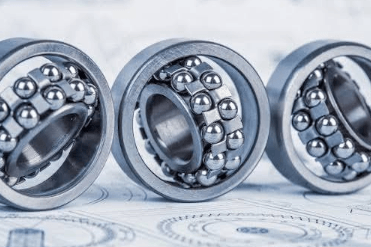
Rotating equipment depends on bearings that can support loads while maintaining alignment, controlling friction, and allowing shafts to operate smoothly. Selecting the right bearing involves more than matching a shaft diameter. Engineers must consider the direction of applied forces, operating speed, lubrication, installation conditions, and the consequences of wear. These details become particularly important when machinery experiences both radial and axial loads.
Tapered roller bearings are commonly used in applications where forces act in more than one direction. Their geometry allows them to support combined loads while maintaining controlled contact between the rolling elements and raceways. Correct selection and installation help improve equipment reliability, reduce unplanned maintenance, and support consistent operating performance.
Understanding Combined Bearing Loads
Radial loads act perpendicular to the shaft, while axial loads act parallel to it. In a conveyor system, for example, a rotating shaft may experience radial forces from belt tension and axial forces from positioning or mechanical thrust. A bearing arrangement must accommodate the expected combination rather than being selected according to only one load value.
The ratio between radial and axial loads influences bearing selection. High radial loads may require substantial load-carrying capacity, while significant axial forces make internal geometry and mounting arrangements especially important. Engineers should also evaluate shock loads, vibration, and changes in force during startup or shutdown.
Why tapered roller geometry matters
Tapered roller bearings use conical rollers and matching raceways. Their contact geometry enables them to support radial and axial forces simultaneously. However, the direction and magnitude of the axial load matter, because a single-row tapered roller bearing generally supports axial load most effectively in one direction.
For applications requiring axial support in both directions, designers often use opposed bearing pairs or another suitable arrangement. The exact configuration depends on the equipment design, expected loads, shaft dimensions, and required positioning accuracy.
Evaluating a Bearing for Industrial Use
A bearing designation can help narrow the selection, but it should not replace a complete engineering assessment. When reviewing a product such as a 32204 bearing confirm the manufacturer’s dimensional information, load ratings, tolerance class, internal design, and recommended operating conditions before specifying it.
Check dimensions and fit
The bore must match the shaft, while the outer diameter and width must fit the housing. Dimensional compatibility alone is not enough. Shaft and housing tolerances influence internal clearance, load distribution, and operating temperature.
An excessively tight fit can reduce internal clearance and increase friction. A fit that is too loose may allow movement between mating components, creating wear or affecting alignment. Engineering drawings and manufacturer guidance should determine the appropriate fits for the application.
Assess speed and temperature
Operating speed affects lubrication requirements, heat generation, and the bearing’s permissible operating range. A bearing intended for moderate-speed industrial machinery may not be appropriate for a high-speed application without checking its ratings and lubrication conditions.
Temperature also affects lubricant viscosity, material behavior, and dimensional relationships. Systems exposed to frequent thermal cycles should be evaluated under realistic operating conditions rather than ambient temperature alone.
Installation Practices That Protect Performance
Even a correctly selected bearing can fail prematurely if installed improperly. Mounting surfaces should be clean, shafts and housings should be inspected, and installation tools should apply force to the correct ring. Force should never be transmitted through the rolling elements during mounting, as this can damage raceways.
Tapered roller bearings may require adjustment of axial clearance or preload, depending on the design. Too much clearance can permit excessive movement and vibration. Excessive preload can increase friction, heat, and fatigue. Follow the manufacturer’s specified procedure and measurement method rather than relying on an arbitrary tightening value.
Lubrication must also be appropriate for the load, speed, temperature, and environment. Too little lubricant can increase wear, while excessive grease can create heat in some operating conditions. Contamination control is equally important: dirt, moisture, and metal particles can damage bearing surfaces and shorten service life.
Maintenance and Failure Prevention
A practical maintenance program combines inspection, operating data, and consistent lubrication practices. Technicians can monitor temperature, vibration, unusual noise, and lubricant condition to identify changes before they cause a major breakdown.
When a bearing fails, replacing it without identifying the root cause may lead to repeated failures. Investigations should consider misalignment, incorrect fits, contamination, insufficient lubrication, overloading, improper adjustment, and mounting damage. Evidence on raceways and rolling elements can help distinguish between these causes.
Maintenance teams should also keep records of installation dates, lubricant types, operating conditions, and inspection results. These records make it easier to identify recurring problems and improve future maintenance schedules.
FAQs
1. What loads can tapered roller bearings support?
They can support combined radial and axial loads. The permitted load depends on the bearing design, arrangement, lubrication, speed, and manufacturer’s ratings.
2. Why does bearing adjustment matter?
Incorrect clearance or preload can increase vibration, friction, and operating temperature. The correct setting depends on the equipment design and manufacturer instructions.
3. How can bearing service life be improved?
Use suitable lubrication, correct mounting fits, effective contamination protection, appropriate load selection, and routine condition monitoring.
Conclusion
Reliable bearing performance starts with understanding the forces and conditions present in the application. Engineers should verify dimensions, load capacity, speed limits, fit, lubrication, and installation requirements before approving a component. A systematic selection and maintenance process helps industrial equipment operate more consistently and reduces avoidable downtime.